

10x10 Trade Show Booth Guide: Sizes, Setup & What It Costs
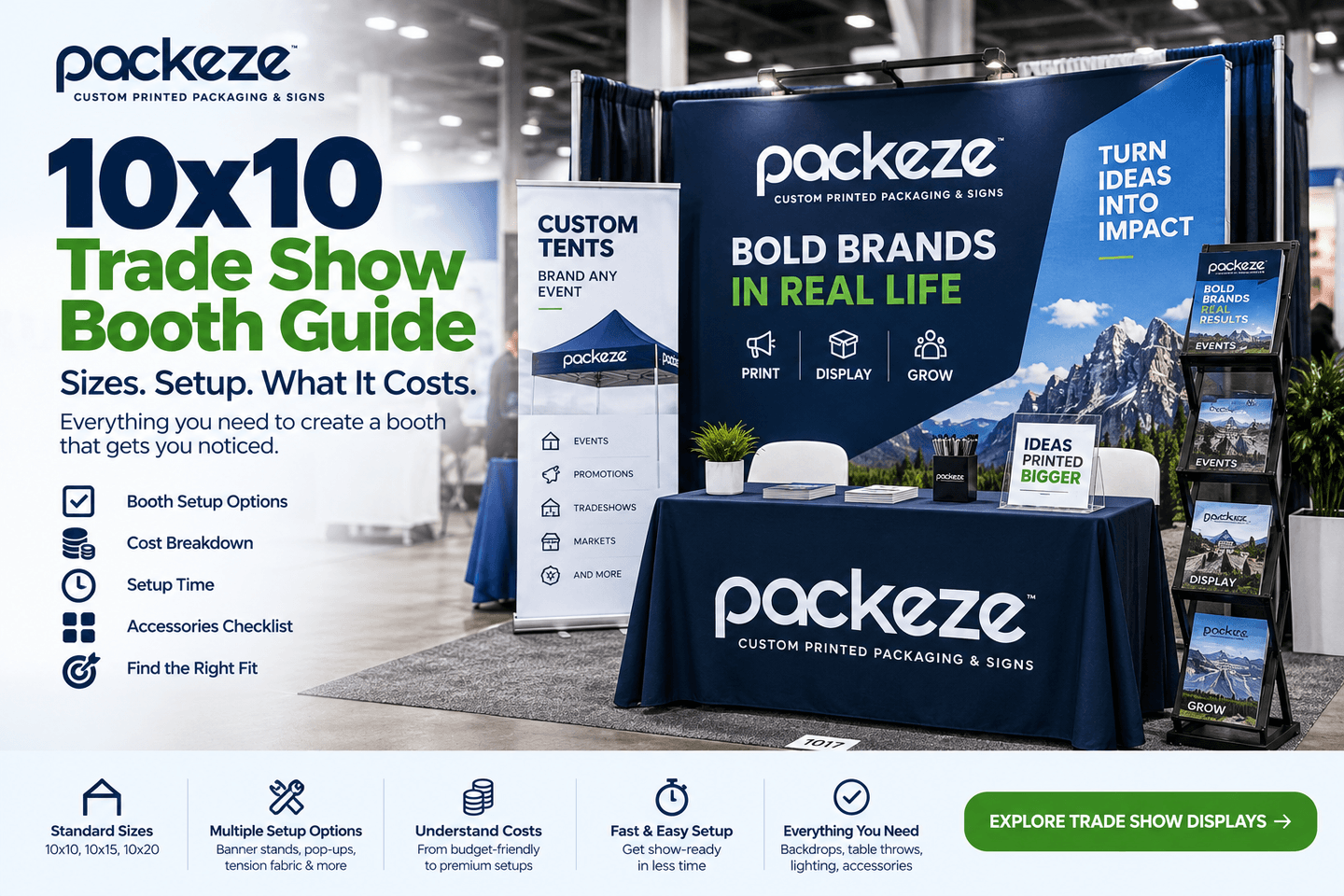
A 10x10 trade show booth is a 10-foot by 10-foot exhibit space, the smallest and most common booth size sold at US trade shows and conventions. It gives you 100 square feet of floor space and is almost always sold as an inline booth, meaning it backs onto a shared pipe-and-drape wall with neighboring exhibitors on either side.
WHAT SIZE IS A 10X10 TRADE SHOW BOOTH?
A 10x10 booth measures 10 feet wide by 10 feet deep, for 100 square feet of total floor space. It's the standard entry-level booth at most convention centers and the size show organizers use as their base unit when they lay out a floor plan — a 10x20 is really just two 10x10s side by side.
WHAT'S INCLUDED IN A 10X10 EXHIBIT SPACE?
In most cases, the show organizer gives you nothing but the floor space itself, plus pipe-and-drape side and back walls and a basic identification sign. Everything else — your backdrop, flooring, furniture, lighting, and graphics — is your responsibility to bring, rent, or buy.
Check your exhibitor manual before you plan anything. Some shows include a table and chairs in the booth fee, some include carpet, and a few charge extra for anything beyond the bare pipe and drape.
WHAT ARE YOUR SETUP OPTIONS FOR A 10X10 BOOTH?
Your main options are a banner stand cluster, a pop-up display, a tension fabric display, or a modular system, and they trade off price, setup effort, and visual impact against each other.
Display type | Setup effort | Best for | Portability
Banner stands | Tool-free, one person, fastest option | First-time exhibitors, tight budgets, multiple small shows | Very portable, fits in a car
Pop-up display | Tool-free, folds open and locks into place | A full 10-foot backdrop without a large travel case | Rolls into a single case, checkable as luggage on some setups
Tension fabric display | Frame assembly plus a stretch-fit fabric graphic | A clean, wrinkle-free look with vivid color | Lightweight frame, fabric graphic packs small
Modular system | Panel-by-panel assembly, sometimes with a crew | Exhibitors who reconfigure the same components into a 10x20 or 10x30 later | Ships in road cases, least portable of the four
Packeze's indoor trade show displays cover all four of these formats, so you can compare them side by side before you decide.
WHAT DOES A 10X10 TRADE SHOW BOOTH SETUP COST?
Cost is driven almost entirely by which display type you choose, not by the fact that the booth is 10x10. A banner stand setup is the cheapest way to fill a 10x10 space. A modular system with custom panels, lighting, and a counter is the most expensive. Tension fabric and pop-up displays sit in between.
Beyond the display itself, the other line items that move your total are graphic complexity (a single large image versus multiple printed panels), whether you add a counter or literature stand, flooring, lighting, and shipping the case to and from the venue. If you're comparing options, request pricing on the specific components at Packeze's indoor trade show displays rather than assuming a flat per-booth number — two 10x10 setups can look identical from across the hall and cost very differently depending on what's behind the graphic.
HOW LONG DOES IT TAKE TO SET UP A 10X10 BOOTH?
Banner stands and pop-up displays are built to be set up by one person without tools, which makes them the fastest option to get on and off the show floor. Tension fabric displays add a frame assembly step before the fabric skin goes on. Modular systems take the longest because panels have to be assembled and aligned, and larger modular builds are sometimes handled by a professional installation crew rather than the exhibitor.
10X10 VS 10X20: WHICH SIZE DO YOU NEED?
Choose a 10x10 if you need a simple presence with one or two staff working the space at a time. Choose a 10x20 if you need room for a demo station, multiple conversation areas, or three or more staff working simultaneously.
Feature | 10x10 booth | 10x20 booth
Floor space | 100 sq ft | 200 sq ft
Typical booth type | Inline, one side open | Inline (two 10x10s combined) or corner, depending on layout
Staffing | 1–2 people | 3+ people
Good for | Lead capture, simple demos, first-time exhibitors | Live demos, seating areas, multiple conversations at once
Many exhibitors start with a 10x10 and later upgrade to a 10x20, which is one reason modular systems that expand from one size to the other are worth considering even for your first show.
WHAT ACCESSORIES DO MOST 10X10 BOOTHS NEED?
Beyond the backdrop itself, most exhibitors add a table throw, a banner stand or two for secondary messaging, flooring or carpet if the venue's bare concrete bothers you, and a literature rack or lead-capture setup at the counter. Lighting is worth adding if your booth is in a darker corner of the hall, since a well-lit graphic reads better from a distance than an unlit one, even at the same print quality.
Packeze's full range of these pieces is on the indoor trade show displays page, grouped so you can build a full 10x10 setup in one order instead of piecing it together from separate suppliers.
SHOULD YOU RENT OR BUY YOUR 10X10 BOOTH?
Buy if you're exhibiting more than once or twice a year and want the same branded look every time. Rent if this is a one-off show, you're testing whether trade shows work for your business, or you need a size or style you won't use again. The break-even point depends on how often you show up and how much a rental costs at your specific venue, so it's worth pricing both before you commit either way.