

Create Your Own Bumper Sticker: Sizes, Materials, and Costs
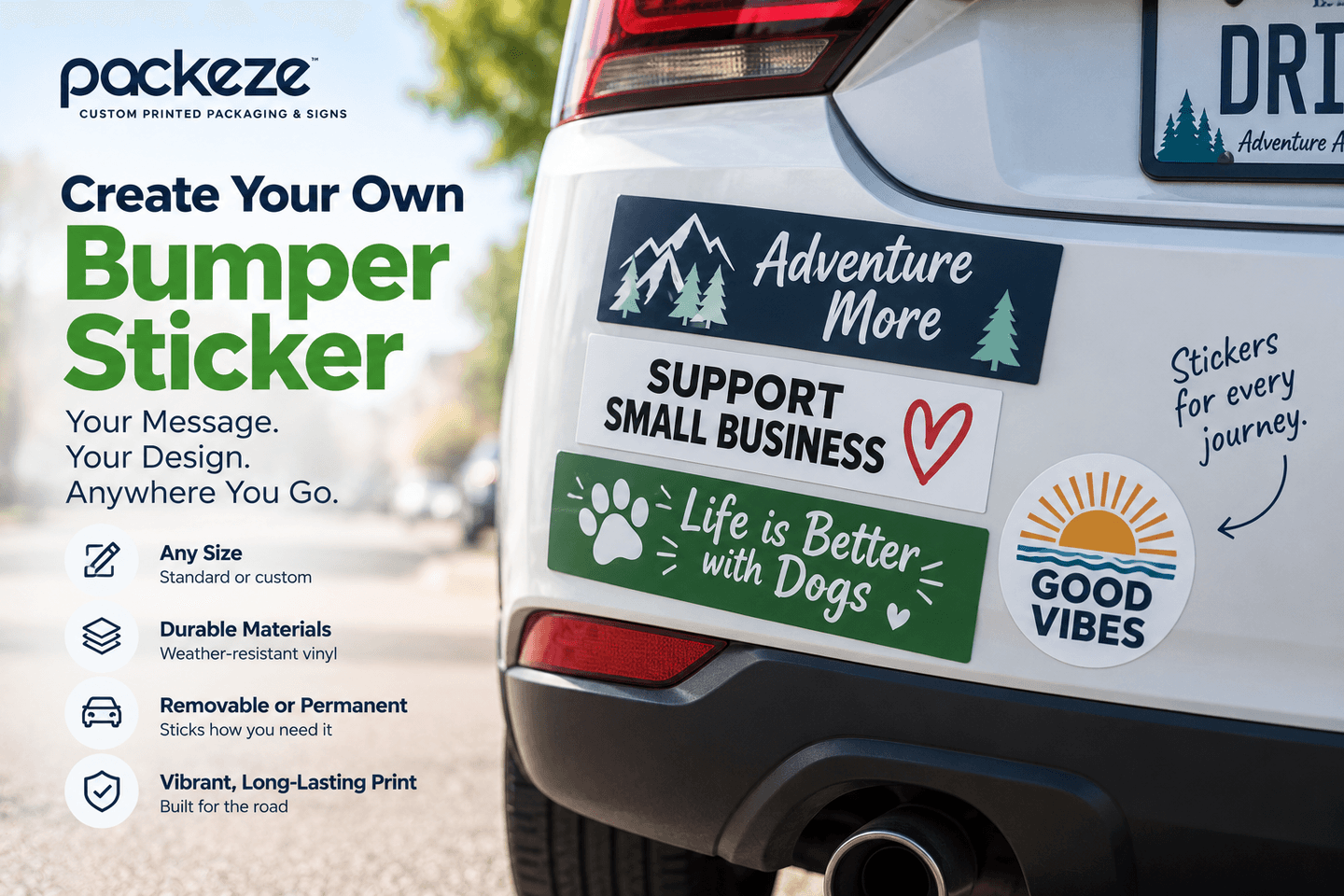
A bumper sticker is a small, cheap way to put a message somewhere it will get seen thousands of times. Before you upload artwork, you need to settle four things: size, material, adhesive, and cut shape. Each one changes how the sticker looks, how long it lasts, and what it costs.
WHAT SIZE IS A STANDARD BUMPER STICKER?
The classic bumper sticker size is 3 x 11.5 inches, sized to fit the width of most car bumpers without wrapping around a curve. Common alternatives include 4 x 4 inch squares for laptops and toolboxes, 5 x 3 inch rectangles for smaller statements, and full custom dimensions when you need something wider or narrower than the standard strip. If you are not sure what fits your bumper, measure the flattest section before you design, since curved or ribbed bumpers can distort a long, thin sticker.
VINYL OR PAPER LAMINATE: WHICH MATERIAL HOLDS UP BETTER?
Vinyl holds up better outdoors; paper laminate is cheaper but shorter-lived. Cast or calendered vinyl with a UV-resistant laminate is built to sit through rain, sun, and car washes for years without cracking or fading. Paper-based stock laminated with a thin film can look identical on day one, but it is more prone to peeling at the edges once it takes real weather. If the sticker is going on a car, a locker, or anything that lives outside, vinyl is the safer buy. If it is a short-run giveaway or an indoor application, paper laminate does the job for less.
SHOULD YOU CHOOSE REMOVABLE OR PERMANENT ADHESIVE?
Permanent adhesive is for stickers meant to stay on a car for years; removable adhesive is for anything you plan to take off later without damage. Permanent adhesive bonds hard into painted metal and glass and resists lifting from washing or weather, but it can leave residue or pull paint if you try to remove it after a long time outdoors. Removable adhesive is the right call for rental cars, laptops, storefront windows, or short political and event campaigns where you know the sticker is coming off eventually.
HOW DO YOU DESIGN YOUR OWN BUMPER STICKER?
You design your own bumper sticker by uploading finished artwork, using an online design tool, or sending a rough idea for a print shop to clean up. If you already have a logo or graphic, upload it directly and set the size and cut shape around it. If you are starting from nothing, a browser-based sticker maker lets you drop in text, shapes, and colors and see a live preview before you order. If your idea is more concept than file, most printers, including Packeze, can take a sketch or a description and turn it into print-ready art.
WHAT FILE TYPE DO YOU NEED TO UPLOAD?
Vector files print sharpest: AI, EPS, or PDF built with real text and paths rather than a flattened image. If you only have a raster image, a PNG or JPG at 300 dpi at the final print size will still reproduce cleanly; anything lower resolution will look soft or pixelated once it is blown up to bumper-sticker size. Text pulled from a low-res screenshot is the most common reason a design gets sent back for a redo, so start with the highest-quality version of your logo or artwork you have.
DIE-CUT VS. RECTANGLE CUT: WHAT'S THE DIFFERENCE?
Die-cut follows the exact outline of your design; rectangle (or square) cut trims it into a plain box shape. Die-cut looks more finished and works well for logos, mascots, or irregular shapes, since there is no blank background showing around the edges. Rectangle cut is faster to produce and generally cheaper, and it is the standard choice for text-based or classic strip-style bumper stickers where a border doesn't hurt the design.
BLANK BUMPER STICKERS VS. CUSTOM PRINTED: WHICH DO YOU NEED?
Blank bumper stickers are uncut or unprinted stock meant for you to write, draw, or stamp on yourself; custom printed stickers arrive with your finished design already on them. Blank stock makes sense for classrooms, craft projects, or anyone who wants a dry-erase or write-on surface rather than a fixed graphic. If you have a logo, slogan, or design you want reproduced accurately and in quantity, custom printing is the option that gets you a finished, ready-to-apply sticker.
WHAT CHANGES THE PRICE OF A CUSTOM BUMPER STICKER?
Price is driven mainly by quantity, size, material, and cut shape, not by any single fixed rate. A few factors that move the number up or down: larger quantities lower the per-unit cost; vinyl with UV laminate costs more than paper laminate; die-cut shapes cost more to produce than simple rectangles; and larger sizes use more material per sticker. Get an exact number by configuring your size, material, and quantity at checkout rather than relying on a rule of thumb, since the mix of those four factors is what actually sets the price.
ORDER YOUR BUMPER STICKERS
Once you know your size, material, adhesive, and cut shape, the rest is uploading your artwork and choosing a quantity. Packeze prints custom bumper stickers to order in vinyl and paper laminate stock, in standard and custom sizes, with removable or permanent adhesive and die-cut or rectangle cut options, from uploaded artwork or an online design tool.