

Custom Flags Guide: Feather vs. Teardrop vs. Banner Flags
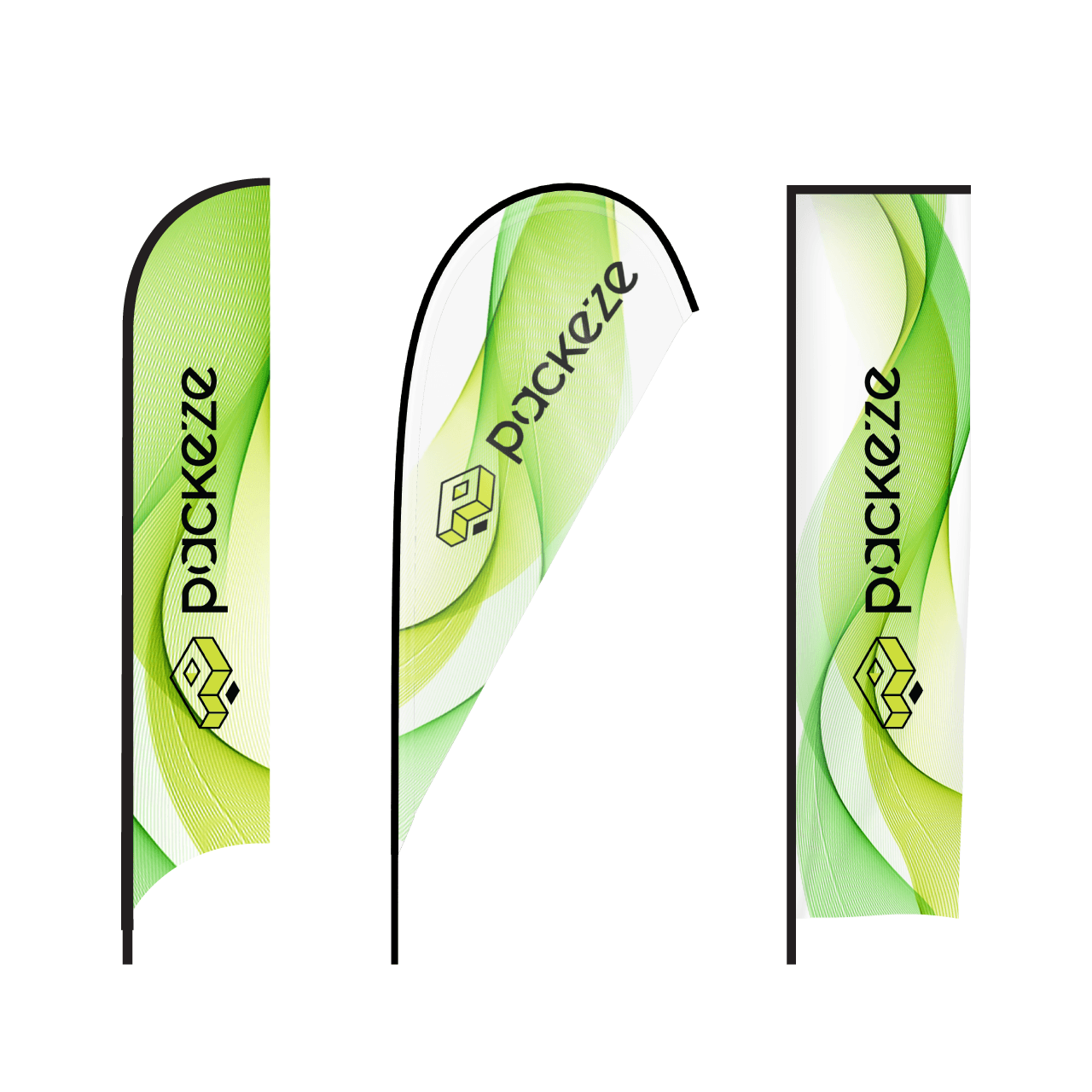
A flag catches attention a sign never will — it moves. If you've ever driven past a car dealership or a grand opening and noticed the flags before you noticed the building, that's the whole pitch. Here's how to pick between feather, teardrop, and rectangle banner flags, get the base right for your surface, and land on a size and price that fits your event.
Feather, teardrop, or rectangle banner: which shape?
Feather flags are the tall, curved shape that tapers to a point at the top. They're the classic choice for storefronts and sidewalks — tall enough to read from a distance, and the curved profile moves gracefully even in light wind, which is exactly what catches a driver's eye at an intersection.
Teardrop flags trade some height for a rounder, sturdier shape that holds up better in stronger wind. If your location is a parking lot, an open field, or anywhere wind is a real factor rather than an occasional breeze, teardrop is the safer pick — it won't whip and tangle the way a feather flag can in gusts.
Rectangle banner flags skip the curved silhouette entirely for a clean, straight-edged rectangle. This is the shape political campaigns, dealerships, and anyone running a matched row of flags tends to reach for — it reads as more structured and uniform when you're placing several in a line.
Sizes and pricing
All three shapes are available from 6 ft up to 14 ft, and pricing runs from about $180 to $390 depending on size, base, and single- vs. double-sided printing. Taller flags read from farther away — a 6-8 ft flag works for a sidewalk or storefront entrance, while 10-14 ft is standard for highway-visible placements and larger event entrances.
See current sizes and configure your flag on the Custom Flags page.
Getting the base right for your surface
The wrong base is the most common reason a flag ends up on the ground. A ground stake works for grass, dirt, or any soft surface — push it in and you're set. For pavement, sidewalks, or a showroom floor, you need a cross base, ideally filled with a water bag for extra weight in wind. Storefronts and vehicle lots without open ground can use a wall or wheel mount instead — mounting directly to a building or a car wheel where staking isn't an option.
If you're not sure which base fits your location, default to a cross base with a water bag — it works on nearly any hard surface and adds the weight a tall flag needs to stay upright in real wind, not just a calm-day demo.
Single-sided or double-sided?
Single-sided printing costs less and reads fine when your flag is seen mostly from one direction — against a wall, or facing a single approach road. Double-sided costs more but reads clearly from either direction, which matters when foot or car traffic approaches your flag from multiple angles, like a flag placed at an open intersection or in the middle of a parking lot.
How long do they last?
Most printed flags hold their color and shape for 6 to 12 months of regular outdoor use. Sun exposure fades color faster than wind wears out the fabric, so a flag in constant direct sun will need replacing sooner than one that gets some shade during the day. If you're running a flag for a single event rather than a season, durability matters less than getting the size and shape right for the moment.
Ready to order? Shop custom flags — feather, teardrop, and rectangle banner shapes, 6 to 14 ft, with pole kits and your choice of base included. Running a booth too? See the full Event & Trade Show Display Packages hub.
FAQ
What's the difference between feather and teardrop flags?
Feather flags have a tall, curved shape that tapers to a point and moves gracefully in light wind. Teardrop flags have a rounder, sturdier profile that holds up better in stronger wind.
How much do custom flags cost?
Custom flags range from about $180 to $390 depending on size, style, and base — feather, teardrop, and rectangle banner shapes are all available in the same price range, from 6 ft up to 14 ft.
What base should I use for a flag on pavement?
Use a cross base, ideally with a water bag for extra weight — ground stakes only work on grass, dirt, or other soft surfaces.
Should I choose single-sided or double-sided printing?
Single-sided is more affordable and works well when your flag faces one direction. Double-sided costs more but reads clearly from either side — worth it anywhere people approach from multiple directions.
How long do outdoor flags last?
Most printed flags hold their color and shape for about 6 to 12 months of regular outdoor use, depending mostly on sun exposure.