

Custom Wall Decal Stickers: Sizes, Materials, and How to Choose
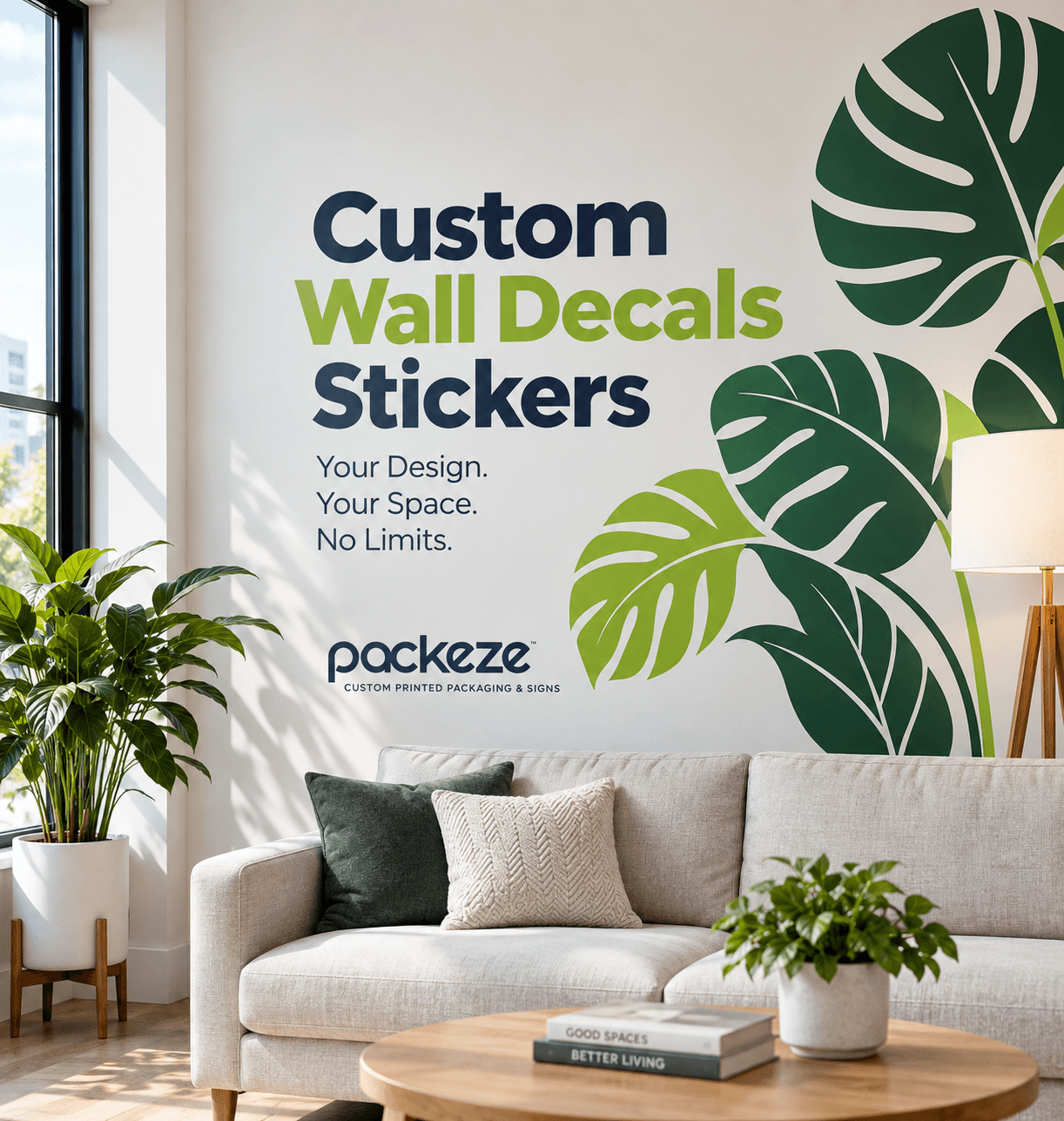
Custom wall decals are printed or cut vinyl graphics applied directly to an interior wall. This guide covers the material choices, sizing, adhesive types, and install questions you need answered before you order.
WHAT IS A CUSTOM WALL DECAL STICKER MADE FROM?
Most custom wall decals are made from self-adhesive vinyl, either calendered vinyl or cast vinyl. Calendered vinyl is thicker and less flexible, which makes it fine for flat walls and shorter-term use. Cast vinyl is thinner, more conformable, and holds up longer, which matters if the wall has texture, corners, or curves.
The graphic is either printed (for full-color designs, photos, or logos) or cut from solid-color vinyl (for text, simple shapes, and single-color graphics). Both are then backed with an adhesive layer and a transfer tape or application tape that lets you position the whole design at once.
WHAT'S THE DIFFERENCE BETWEEN WALL VINYL AND WALLPAPER VINYL?
They're usually the same base material sold for two different jobs. "Wall vinyl" or "wall decal" typically refers to a smaller cut or printed graphic — a quote, logo, or design — applied to one section of a wall. "Wallpaper vinyl" typically refers to a large-format covering, sold in wide panels or a continuous roll, meant to cover most or all of a wall edge to edge.
The practical difference is installation. A single decal is a one-piece application. Wallpaper vinyl covering a full wall usually means multiple panels hung in sequence with pattern-matched or butted seams, which takes more time and more care to get straight.
WHAT SIZES DO CUSTOM WALL DECALS COME IN?
Custom wall decals can be made to any size within the width of the vinyl roll, since each one is printed or cut to order. Print vinyl commonly comes off rolls in standard widths — 54 inches is a common one in the sign industry — so a decal up to that width prints as a single piece.
• Small graphics — lettering, quotes, small logos, typically under 24 inches on the long side.
• Medium graphics — logos, wall art, single-panel murals in the 2 to 5 foot range.
• Large or full-wall installs — anything wider than the roll gets split into multiple panels and seamed on the wall, which is standard practice for full accent walls.
REMOVABLE OR PERMANENT: WHICH ADHESIVE DO YOU NEED?
Removable adhesive is the right call for rented spaces, retail resets, temporary branding, or anywhere you expect to take the graphic down. Permanent adhesive is the right call for a graphic you intend to leave up indefinitely and don't plan to reposition.
Feature | Removable adhesive | Permanent adhesive
Best for | Rentals, temporary displays, seasonal graphics | Long-term installs, owned walls
Repositionable | Yes, usually within the first application | No, once it's down it's down
Removal | Peels off cleanly from most cured, painted walls | Can leave adhesive residue or take paint with it
Grip over time | Slightly weaker long-term hold | Stronger long-term hold
MATTE, GLOSSY, OR TEXTURED: WHICH FINISH HOLDS UP BEST ON WALLS?
Matte finish is the most common choice for walls because it hides minor wall texture and doesn't reflect room lighting. Gloss finish makes colors look more saturated but will show every bump, seam, and fingerprint on the wall underneath it. Textured or fabric-look vinyl is built to mimic a wallpaper feel and is the better match if you want the decal to read as a wall covering rather than a sticker.
HOW DO YOU INSTALL A WALL DECAL WITHOUT AIR BUBBLES?
- Clean the wall and let it dry fully — dust and moisture are the two most common causes of bubbles and lifting edges.
- If the wall was recently painted, wait for the paint to fully cure before applying vinyl; fresh paint is soft and won't hold adhesive properly.
- Peel back a few inches of the backing at a time rather than removing it all at once.
- Use a squeegee or a credit card to work outward from the center, pushing air toward the edges.
- For anything wider than about two feet, use application tape to hold the design in place while you apply it, so it goes on straight and in one pass.
WILL REMOVING A WALL DECAL DAMAGE PAINT OR DRYWALL?
It depends on the adhesive type and the condition of the paint underneath, not on the decal itself. Removable vinyl applied to a fully cured, good-quality painted wall should peel off cleanly. Permanent vinyl, or vinyl applied to fresh paint, flat builder-grade paint, or unprimed drywall, can pull paint off with it when removed.
If you're unsure how long a graphic will stay up, choose removable adhesive and confirm the paint has cured for at least a few weeks before applying anything.
WHAT DRIVES THE PRICE OF A CUSTOM WALL DECAL?
Price is driven by size, quantity, and complexity rather than by the fact that it's a wall decal. The main factors are:
• Total square footage — larger graphics use more material and more press time.
• Number of panels — a full-wall install that requires seaming multiple pieces costs more to produce and align than a single-piece decal.
• Print complexity — a full-color printed graphic costs more to produce than a single-color cut vinyl design.
• Adhesive and finish — specialty finishes and removable adhesive can shift the base material cost.
• Quantity — ordering multiples of the same design brings the per-unit cost down.
Because these variables change the price so much from job to job, the only accurate number is a quote against your actual size, quantity, and design.
CUSTOM WALL DECAL VS. WALLPAPER VS. PAINTED MURAL: WHICH SHOULD YOU CHOOSE?
Feature | Wall decal | Wallpaper | Painted mural
Install time | Fast, often same day | Slower, multiple panels to align | Slowest, requires a painter
Removable | Yes, with the right adhesive | Sometimes, depends on the product | No, requires repainting to change
Best for | Logos, quotes, accents, temporary or rental spaces | Full-room coverage, permanent design commitment | One-of-a-kind art, permanent spaces
Damage risk on removal | Low with removable adhesive on cured paint | Moderate, depends on wall prep | Not applicable, it's paint
Turnaround for a new design | Fast — reprint and reapply | Slower and more expensive to change | Requires a repaint
WHAT FILE DO YOU NEED TO SUBMIT TO GET A WALL DECAL MADE?
A vector file — AI, EPS, or a vector PDF — is the preferred format because it scales to any wall size without losing quality. If you only have a raster file (JPEG, PNG), it needs to be high resolution, roughly 300 DPI at the final printed size, or it will look soft when it's blown up to wall scale.
Bleed isn't usually needed on a wall decal the way it is on a printed sign, but let your printer know whether you want the graphic kiss-cut (weeded around a shape) or left as a full rectangle, since that changes how the file needs to be set up.
ORDERING A CUSTOM WALL DECAL STICKER
A custom wall decal is a straightforward order once you know three things: the size you need, whether the adhesive should be removable or permanent, and whether the design is full color or single color. From there it's a matter of matching the material and finish to where it's going — a rental apartment, a retail wall, an office lobby, or a full accent wall.
Packeze produces custom wall decal stickers cut and printed to size, in removable or permanent vinyl, for single graphics or full multi-panel wall installs.