

Custom Wristbands Buyer's Guide: Tyvek vs Silicone vs Vinyl, Numbering & Bulk Pricing
WHAT'S THE BEST MATERIAL FOR CUSTOM WRISTBANDS?
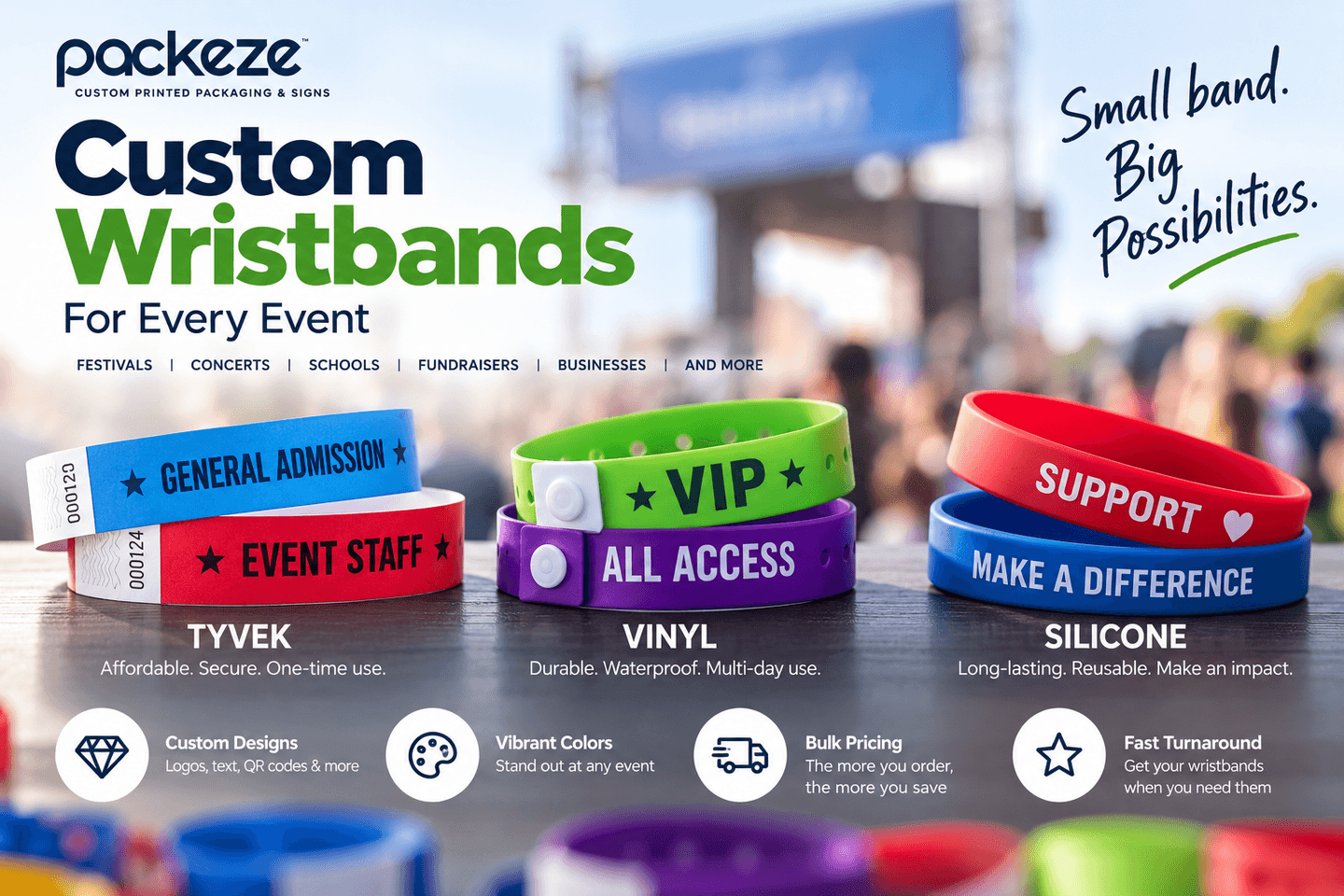
For a single-day event, Tyvek is the standard choice because it's cheap and tamper-evident. For a wristband people keep and wear again — a gym membership, a fundraiser, a reusable festival pass — vinyl or silicone hold up better. There's no single "best" material; the right one depends on whether the wristband needs to survive one night or one year.
WHAT IS A TYVEK WRISTBAND?
A Tyvek wristband is a paper-like synthetic band with an adhesive tab, designed to be worn once and thrown away. Tyvek is a spun-bond polyethylene material — it's the same stuff used for shipping envelopes and construction wrap, so it resists tearing and doesn't absorb water the way paper does, but it's not meant to be removed and reused. Once the adhesive tab is sealed, pulling it off usually tears it, which is exactly the point at gated events and bars checking age or paid entry.
Tyvek is the lowest-cost option of the three and prints well in single or full color, which is why it's the default for concerts, races, festivals, and one-day conferences.
WHAT IS A VINYL (PLASTIC) WRISTBAND?
A vinyl wristband is a flexible plastic band, usually with a snap-lock or slide-lock closure, built to survive water, sweat, and multiple wearings across a multi-day event. Vinyl sits between Tyvek and silicone on both cost and durability — it costs more than Tyvek but less than most silicone options, and it holds up through swimming, showering, and several days of wear without falling apart.
Vinyl is common for water parks, multi-day festivals, and hospital or healthcare ID bands where a paper band would degrade.
WHAT IS A SILICONE WRISTBAND?
A silicone wristband is a solid rubber band, often debossed or embossed with a design rather than just printed, made to be worn for months or handed out as a keepsake. Silicone is the most durable of the three materials and the one most associated with cause-awareness bands, team merchandise, and giveaways meant to last — it doesn't tear, and colors can be molded into the band itself rather than just printed on the surface.
It's also the most expensive option per unit, so it's rarely the right pick for a one-night event where the band gets cut off at the door.
TYVEK VS VINYL VS SILICONE: SIDE-BY-SIDE COMPARISON
Material | Typical use | Durability | Closure type | Relative cost
Tyvek | Single-day events, bars, concerts, races | One-time wear; tears if removed | Adhesive tab | Lowest
Vinyl | Multi-day festivals, water parks, healthcare | Water-resistant, several days of wear | Snap-lock or slide-lock | Middle
Silicone | Fundraisers, team gear, long-term giveaways | Months of wear; won't tear | Continuous band, no closure needed | Highest
DO CUSTOM WRISTBANDS NEED SEQUENTIAL NUMBERING?
Sequential numbering is worth adding whenever you need to track individual attendees, control re-entry, or reconcile how many wristbands were actually handed out against how many were printed. It's not required for a general-admission event where anyone with a band gets in, but it matters for ticketed events, VIP tiers, drink or item redemption, and any situation where you need to match a number on a wristband to a name on a list.
Numbering can run as plain sequential digits, or as a barcode or QR code if you need to scan bands at the door rather than read them by eye. QR and barcode options add a design and printing step, so flag that requirement before you finalize artwork.
HOW DOES BULK PRICING WORK FOR CUSTOM WRISTBANDS?
Per-unit cost drops as order quantity goes up, which is true across all three materials — Tyvek, vinyl, and silicone all price on a quantity curve rather than a flat per-band rate. The practical decision isn't whether to order in bulk, it's estimating attendance correctly: ordering short means a mid-event scramble for a rush reprint, and ordering long leaves you paying for bands that never leave the box. For a multi-day or recurring event, ordering slightly above your expected headcount is usually cheaper than a second short-run reorder later.
WHAT SIZES DO CUSTOM WRISTBANDS COME IN?
Custom wristbands typically come in three standard lengths: adult, youth, and child, with adult being the size most commonly ordered by default unless you specify otherwise. Adult bands run roughly 10 inches long, youth bands roughly 9 inches, and child bands roughly 7.5 inches — enough to fit comfortably without sliding over a hand. If your event serves a mixed audience, ordering a split of adult and youth sizes avoids bands that are either too loose to stay on or too tight to close.
ADHESIVE, SNAP-LOCK, OR SLIDE-LOCK: WHICH CLOSURE DO I NEED?
• Adhesive tab — single use, tears on removal, standard on Tyvek bands. Right choice when you want to be certain a band can't be passed to someone else.
• Snap-lock — a plastic pin snaps into a hole, common on vinyl bands. Removable with scissors but not by hand, good for multi-day events where staff need to cut bands off at checkout.
• Slide-lock — a plastic tab slides through a track and locks in place, also common on vinyl. Similar security to snap-lock, slightly easier to apply one-handed.
WHERE TO BUY CUSTOM WRISTBANDS
Packeze prints custom wristbands in Tyvek, vinyl, and silicone with sequential numbering and barcode options available on request. See sizes, closures, and current turnaround on the custom wristbands product page to spec out an order.