

Personalized Yard Signs: Sizes, Materials, and How to Order Yours
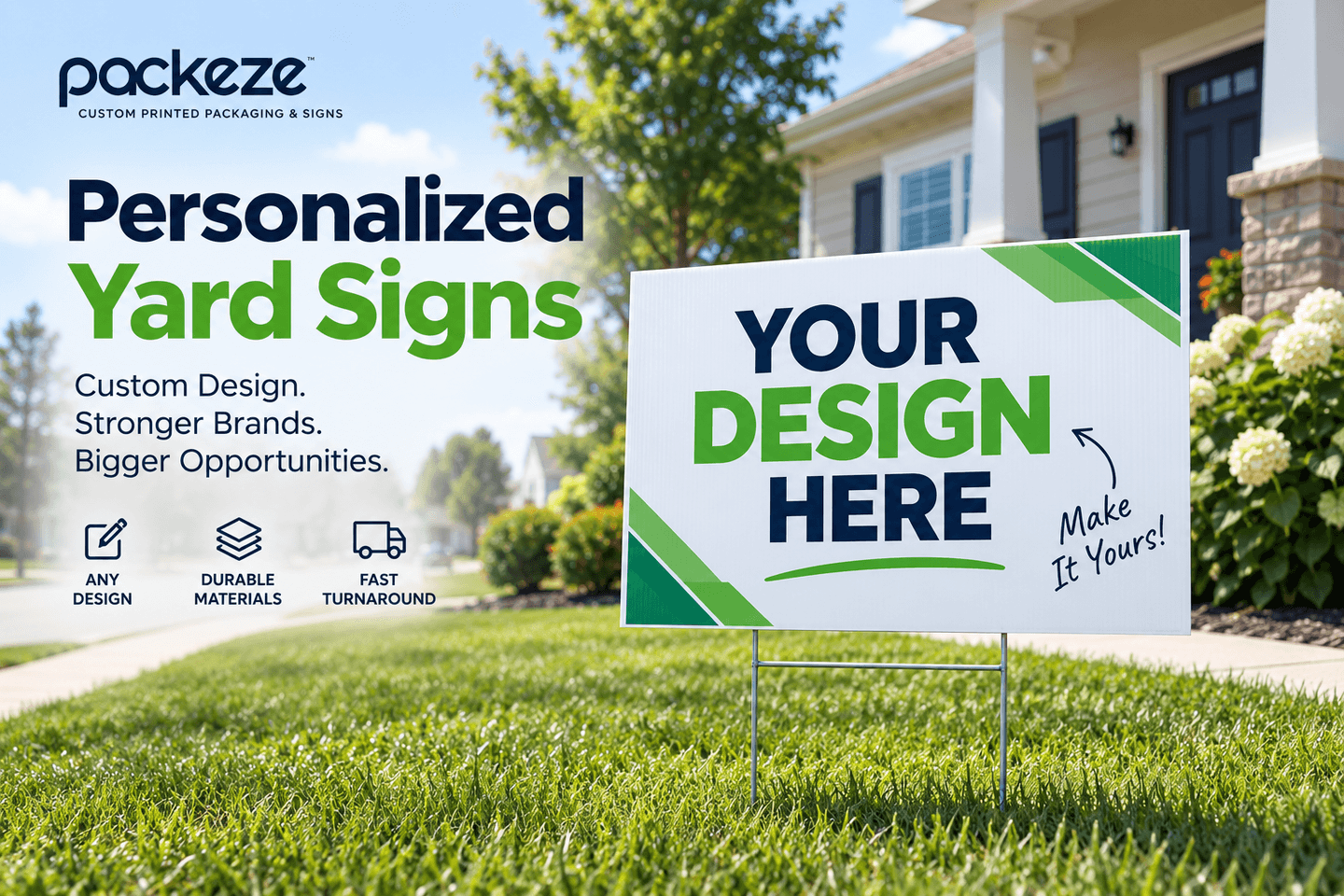
A personalized yard sign is a custom-printed sign, usually on corrugated plastic or aluminum, staked into the ground to advertise a business, promote a real estate listing, mark a political campaign, or announce an event. It's the same physical product whether you call it a custom lawn sign, a custom yard sign, or a business lawn sign — the naming difference is mostly about who's buying it and why.
WHAT IS A PERSONALIZED YARD SIGN?
It's a rigid, weather-resistant sign printed with your own text, logo, and images, mounted on a wire H-stake so it stands upright in grass or soil. Most are single-panel signs between 12 and 36 inches wide, printed on one or both sides, and designed to survive outdoors for a single campaign or several seasons depending on the material.
The three things that separate one yard sign from another are size, material, and whether it's printed on one side or two. Everything else — shape, color, stake style — is a variant of those three decisions.
WHAT SIZES DO PERSONALIZED YARD SIGNS COME IN?
Most personalized yard signs are sold in a handful of standard sizes, and picking the right one depends on where the sign will be read from — a sidewalk, a driveway, or a road at 35 mph.
Size | Best for | Typical read distance
12" x 18" | Open house directionals, garage sales, small events | Up to ~50 ft
18" x 24" | Real estate, election yard signs, general business use | ~75-100 ft
24" x 18" (landscape) | Business lawn signs read from a driveway or parking lot | ~75-100 ft
24" x 36" | Roadside advertising, larger events | ~150 ft+
36" x 24" | High-traffic road frontage, construction sites | 150 ft+
As a rule of thumb: double the sign height in feet, and that's roughly the distance in yards a driver can read three or four words on it at speed. A sign meant to be read from a car needs to be at least 18" x 24"; anything smaller is really a pedestrian sign. You can browse current sizes and get a quote on personalized yard signs.
WHICH MATERIAL SHOULD I PICK: COROPLAST, ALUMINUM, OR PVC?
Corrugated plastic (coroplast) is the standard choice for most yard signs because it's light, cheap, and holds up for one to two outdoor seasons. Aluminum and PVC cost more but last longer and don't flex in wind the way coroplast does.
Material | Typical lifespan outdoors | Weight | Good for
Corrugated plastic (coroplast) | One to two seasons | Very light | Elections, open houses, short-term promotions
PVC / Sintra | Two to four years | Light-moderate | Business signage reused year after year
Aluminum | Five-plus years | Heavier, rigid | Permanent-feeling signage, high-wind areas
The trade-off is straightforward: coroplast is the cheapest per sign and the easiest to replace, so it makes sense when you need a lot of signs for one campaign. Aluminum costs more up front but you're not reordering next year. If a sign will sit outside longer than a few months, or it's your only business sign, PVC or aluminum is worth the extra cost. See material options on the yard signs product page.
HOW DO I DESIGN MY OWN YARD SIGN?
You design a yard sign by choosing a size and material, then either uploading finished artwork or building the design in an online yard sign maker using a template. Most people who search for a "yard sign maker" want one of two things: a blank canvas to build from scratch, or a template they can drop their own text and logo into.
• Keep it to one message. A sign read from a car has about two seconds of attention. One headline, one phone number or website, done.
• Use high-contrast colors. Dark text on a light background (or the reverse) reads at a distance far better than color-on-color combinations.
• Size your text to the sign. As a starting point, headline text should be at least 3 inches tall on an 18" x 24" sign to be legible from the street.
• Leave a border. Text or logos printed too close to the edge can get trimmed or lost against the stake.
• Upload print-ready art if you have it. A designer-made PDF or high-resolution image will always print sharper than text typed into a generic template.
Start a design on the yard sign product page.
SINGLE-SIDED OR DOUBLE-SIDED: DOES IT MATTER?
It matters if the sign will be seen from both directions — most yard signs are read by traffic moving both ways on a street, so double-sided printing is the more common choice for anything placed near a road. Single-sided signs make sense when the sign backs onto a wall, fence, or another sign, or when budget is tight and the sign only faces one direction of foot or car traffic.
WHAT SHOULD A BUSINESS LAWN SIGN ACTUALLY SAY?
A business lawn sign works best with one clear offer or identifier and a way to act on it — not a full list of services. The signs that get results tend to follow the same short structure:
• Business name or logo — for brand recognition, especially if the sign is up long-term
• One short message — "Now Hiring," "Grand Opening," "20% Off This Weekend" — not several messages competing for attention
• One contact method — phone number, website, or QR code, not all three
• Enough white space — a sign packed edge to edge with text is unreadable from a car
DO I NEED A STAKE OR A FRAME?
Yes, if the sign is going into grass or dirt — a wire H-stake is the standard way to mount a yard sign and most sizes are made to fit one. For hard surfaces like pavement or concrete, you'll need a different base or frame instead of a stake, since stakes have nothing to grip. Stakes and mounting hardware are sold alongside the signs on the yard signs page.
HOW MANY SIGNS DO I NEED?
That depends entirely on the use case, but the general logic is: one sign per line of sight, not per location. For an election campaign or neighborhood promotion, that usually means a sign visible from each direction of approach on every street you want covered — which is why orders for campaigns and canvassing tend to run much larger than a single real estate listing or storefront, where two or three signs (front yard, curb, and a directional sign) is often enough.