

Political Yard Sign Rules & Regulations: A Campaign's Placement Guide

You ordered the signs, they arrived, and now a volunteer is standing next to a truck bed full of corrugated plastic asking the one question every campaign eventually asks: where are we actually allowed to put these? Put a sign in the wrong spot and it disappears, draws a complaint, or lands your candidate a story you don't want. Put it in the right spots and it works all season. Here is how sign rules actually operate, and how to keep your placements clean.
A note up front: rules vary from one town to the next, and this is general guidance, not legal advice. Before you deploy, check your city or county sign ordinance and your state election office. When in doubt, ask your local clerk.
The court case that shapes every local sign rule
In 2015 the Supreme Court decided Reed v. Town of Gilbert, and it reset how towns can regulate signs. Gilbert, Arizona had written a sign code that treated a political sign differently from a church directional sign differently from an ideological sign. The Court struck that down. A government cannot regulate a sign based on what it says.
What survived is regulation based on physical traits that have nothing to do with the message: how big a sign is, how many you can put on a lot, how close it sits to the road, what it's made of, and how long it can stay up. So when your city limits yard signs to, say, six square feet and one per street frontage, that rule has to apply to a "For Sale" sign and a "Vote Smith" sign the same way. Knowing this helps you read an ordinance quickly. Look for the size and number limits, and ignore anything that tries to single out political messages, because that part probably won't hold up.
Where you can place signs
Your own yard is the safest ground you have. The Supreme Court protected residential signs back in 1994 in City of Ladue v. Gilleo, ruling that a town could not ban a homeowner from displaying a sign on her own property. Your front lawn and your window are strong, well-settled places to put a sign.
Beyond your own property, you can place a sign on any private lot when the owner agrees. That covers a supporter's lawn, a business that backs your candidate, and a rental where the tenant says yes. Get the yes first. A sign placed without permission is the fastest way to turn a potential supporter into a complaint.
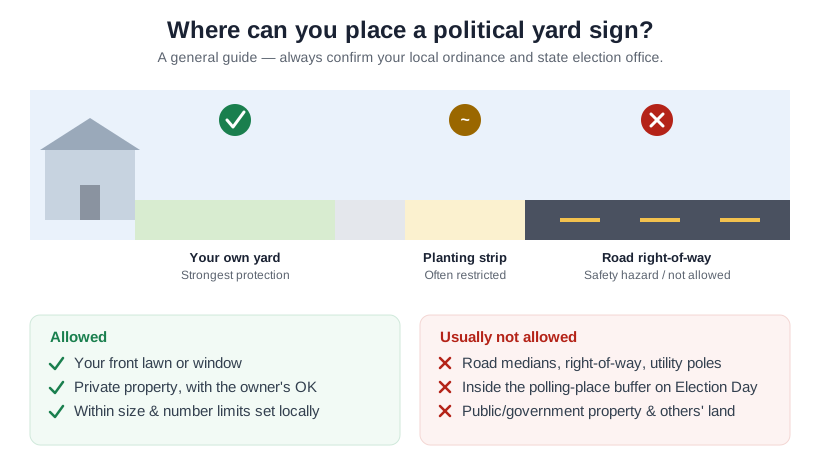 Caption: A quick read on placement zones. Your lawn is protected; the strip between sidewalk and curb is a gray area; the road right-of-way is off limits.
Where you usually can't
Trouble almost always lives in the same few places.
The road right-of-way is the big one. That's the public strip along a road, including medians, traffic islands, and the ground around utility poles. Michigan's transportation department, like many others, prohibits signs there because a sign near a driver's sightline is a safety hazard. Crews clear these routinely, and a sign you staked in a median is a sign you won't see again.
The planting strip, that patch of grass between the sidewalk and the curb, is genuinely murky. Some jurisdictions treat it as a public forum where speech is protected; others fold it into the right-of-way and ban signs outright. Because it splits both ways, check your local rule before you use it, and treat it as a maybe rather than a yes.
Public and government property is out. City halls, schools, parks, and public buildings are not yours to sign. Neither is anyone else's private property without their permission, no matter how good the corner looks.
Polling places have their own rule
Election Day comes with a restriction that does hold up in court, even though it targets political speech directly. In Burson v. Freeman the Supreme Court upheld a buffer zone around polling place entrances where campaigning and signs are banned. The point is to protect voters from pressure at the door. The size of that buffer is set by your state and commonly runs around 100 feet from the entrance, though the exact distance varies. Keep your signs and your volunteers outside it, and confirm the number your state uses before the polls open.
Timing: when to put them out, when to take them down
Two timing questions come up every cycle.
On the front end, many towns once capped how many days before an election a sign could go up. After Reed, blanket durational limits like that are on shaky ground, but plenty of ordinances still list them, so read yours. As a practical matter, most campaigns start heavy sign deployment four to eight weeks out, when name recognition matters and the signs still look fresh on Election Day.
On the back end, removal deadlines are common and enforceable. A typical ordinance gives you a set window after the election, often somewhere between a few days and two weeks, to take your signs down. Miss it and the city may remove them and, in some places, bill the campaign. Build sign pickup into your post-election plan the way you built out placement.
Add the disclaimer to the artwork
This one belongs on the sign itself, not in the placement plan. Federal and many state rules require a "Paid for by" disclaimer identifying the committee behind the ad. Get that language right before you print, because fixing it means a reprint. Your state election office publishes the exact wording it expects.
If a sign gets removed or stolen
Signs vanish. Sometimes a city crew pulls one from the right-of-way, which is legal. Sometimes an opponent or a passerby takes one off private property, which usually is not, and in many states destroying or stealing a lawfully placed campaign sign is its own offense. Document the loss, report a pattern to local officials, and keep a replacement buffer on hand so a stretch of stolen signs doesn't leave a neighborhood bare. This is exactly why campaigns order 10 to 20 percent more signs than the map calls for.
The pre-placement checklist
Before your team fans out, run this list. It catches the mistakes that cost campaigns signs and goodwill. (Image on top of page)
Caption: Seven checks before the first stake goes in the ground.
Get sign placement right and yard signs earn their keep all season for a few dollars each. Get it wrong and you're reprinting, apologizing, or explaining. A little homework on your local ordinance is the cheapest insurance your campaign will buy.
Ready to stock up, including that replacement buffer? [Shop political yard signs and campaign bundles → /political-yard-lawn-signs/] — corrugated plastic, full color, stakes included, with bulk pricing built for candidates. Pair them with sturdy [H-stakes → /product/h-stakes] so every sign you place stays standing.
FAQ
Can you put political signs on public property? Usually no. Public and government property, including parks, schools, and the road right-of-way, is off limits. Political signs belong on private property with the owner's permission, starting with your own yard.
Is it illegal to remove someone's political signs? Often, yes. Taking or destroying a campaign sign that's lawfully placed on private property is a violation in many states. A city crew removing a sign from the public right-of-way is a different situation and is generally allowed.
When should a campaign put out yard signs? Most campaigns begin heavy deployment four to eight weeks before the election. Check your local ordinance first, since some still list a start-date window even though blanket timing limits are legally weaker after Reed v. Town of Gilbert.
How long after an election do signs have to come down? Many ordinances require removal within a set window after the election, commonly a few days to two weeks. Miss the deadline and the city may pull the signs and bill the campaign, so plan pickup in advance.
How far from a polling place can signs go on Election Day? States set a buffer zone around polling place entrances where signs and campaigning are banned, commonly around 100 feet, though the distance varies. Confirm your state's number and keep signs and volunteers outside it.