

Yard Sign Sizes & Materials: 18x24 vs 24x36, Coroplast Thickness, Single vs Double-Sided
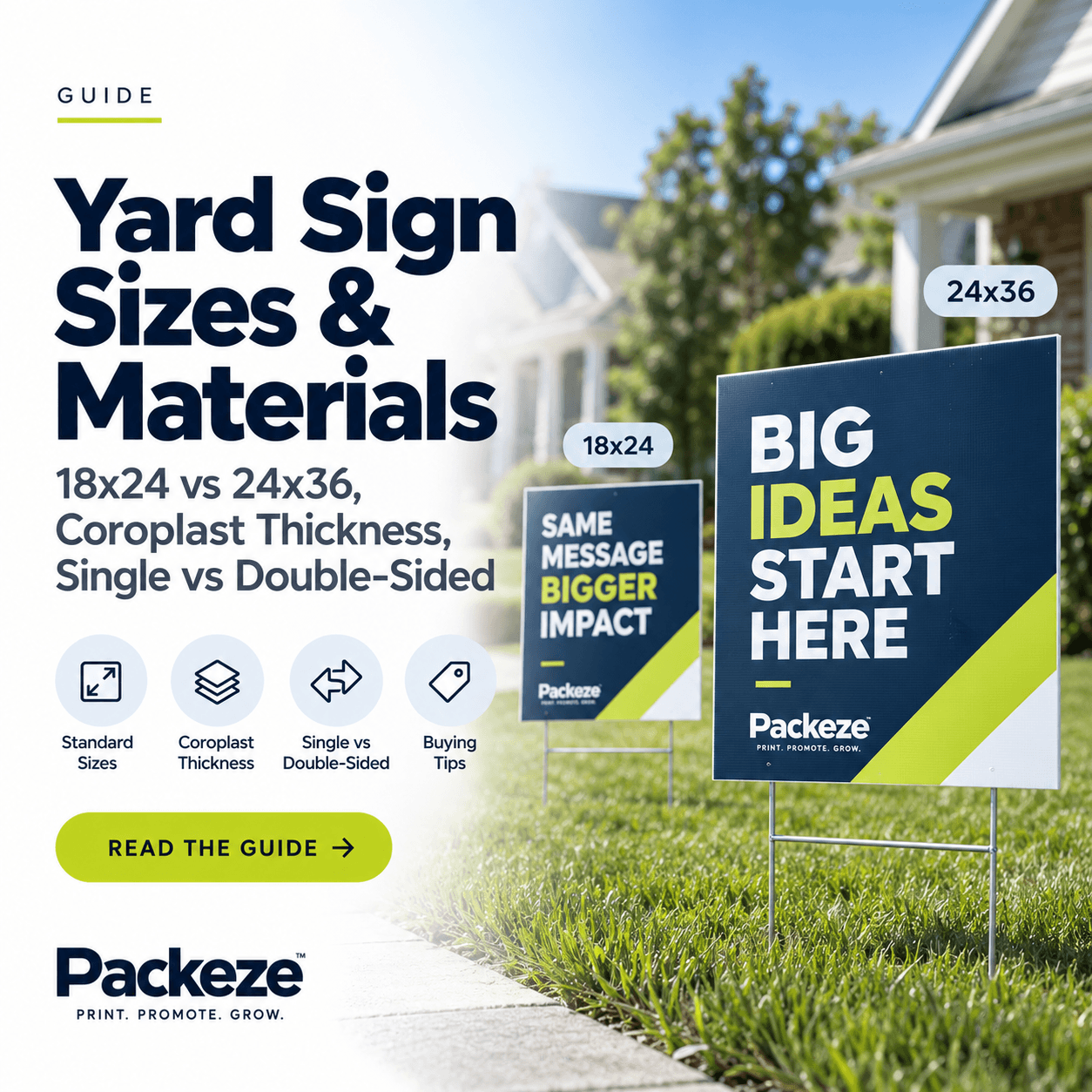
Most yard signs sold in the US are corrugated plastic (coroplast), printed on 4mm or 10mm stock, in one of a handful of standard sizes. The two you'll see most are 18x24 and 24x36. This guide covers how to pick between them, what coroplast thickness actually changes, and when single-sided printing is enough.
WHAT SIZE YARD SIGN SHOULD I USE?
Use 18x24 for signs read up close or at low speed - open house directionals, garage sale signs, HOA notices. Use 24x36 for anything meant to be read from a moving car or across a parking lot - political campaigns on busy roads, contractor job-site signs, event signs on a highway frontage. The larger the sign, the farther away it stays legible, which matters more than most buyers expect until they've put a small sign on a fast road and watched nobody read it.
18X24 VS 24X36: WHICH ONE DO I NEED?
Factor | 18x24 | 24x36
Typical use | Real estate directionals, garage sales, yard notices, residential streets | Political and campaign signs, roadside advertising, contractor and job-site signs
Read distance | Short to medium - foot traffic and slow residential streets | Longer - suited to signs read from a moving vehicle
Stake spacing needed | Fits a standard single H-stake | May need a wider or double H-stake for wind stability
Cost per sign | Lower - less material | Higher - more material
Best for bulk runs | Yes - the default size for large-quantity real estate or event orders | Used for bulk too, but usually where visibility matters more than unit cost
If you're not sure which to pick, 18x24 is the safer default for anything placed close to where people walk or park. Step up to 24x36 only if the sign has to work from the road.
WHAT OTHER SIZES ARE AVAILABLE?
Beyond the two most common sizes, yard signs are typically offered in:
• 12x18 - small directional signs, low-visibility placements
• 18x24 - the most common general-purpose size
• 24x18 (landscape orientation of the same size)
• 24x36 - large-format, roadside-visible
• 36x24 (landscape orientation)
• Custom sizes - cut to a specific dimension for a particular install location
See the full range on the yard signs product page.
WHAT IS COROPLAST, AND WHY IS IT THE STANDARD YARD SIGN MATERIAL?
Coroplast is corrugated plastic sheet - the same fluted, hollow-core construction as cardboard, but made from polypropylene instead of paper. It's the standard yard sign material because it's light enough to stake in soft ground, holds up in rain without going soft, and is cheap enough to print in bulk and treat as disposable after a season or an event.
WHAT COROPLAST THICKNESS SHOULD I ORDER?
4mm is the standard thickness for most yard signs - it's what you get by default on real estate, political, and event signs. 10mm is a heavier-duty option used where the sign will be up longer, handled more, or exposed to harsher wind, since the thicker flute resists bending and tearing better.
Thickness | Feel | Best for
4mm | Standard, lightweight, flexes easily | Short-to-medium term placements: real estate, campaigns, single events
10mm | Noticeably stiffer and heavier | Longer-term outdoor placements, high-wind areas, or signs that get moved and handled repeatedly
SINGLE-SIDED VS DOUBLE-SIDED: WHAT'S THE REAL DIFFERENCE?
Single-sided printing shows your design on one face only; the back is blank. Double-sided printing prints both faces so the sign reads correctly from either direction of travel.
The trade-off is straightforward: single-sided only works if you know which direction traffic will approach from - for example, a sign facing one side of the street. Double-sided is the right call for any sign that could be seen from either direction, which is most roadside and yard placements. The cost of printing both sides is higher than printing one, since it's more ink and more production time, but for a sign meant to be read by drivers going either way, a blank back defeats the point of putting the sign up at all.
Coroplast is technically translucent enough that a double-sided print can show a faint shadow of the opposite side's design through the material in bright backlight. This is a known characteristic of the material, not a print defect, and it's rarely noticeable at normal viewing distance.
DO I NEED AN H-STAKE OR A WIRE STAKE?
An H-stake (a wire frame shaped like an H) is the standard mount for 18x24 and 24x36 coroplast signs - it slides into slots on the back of the sign and pushes into the ground. Wire stakes work the same way but are typically lighter-gauge, used for smaller signs or softer ground. Larger signs or windy sites generally hold better with a wider H-stake or two stakes rather than one narrow one.
HOW DO I DECIDE BETWEEN A STANDARD SIZE AND A CUSTOM SIZE?
Go with a standard size (18x24 or 24x36) if the sign is going into a normal yard, roadside, or event placement - it's faster to produce and matches standard stakes and frames. Go custom only if you have a specific space constraint (a fence panel, a narrow gap, a fixed frame) that a standard size won't fit. For most orders, a standard size on 4mm coroplast, double-sided, is the practical default - browse sizes and materials on the yard signs page.