

Which Custom Tent Do You Need? Event, Food, Festival & Farmers-Market Tents Compared
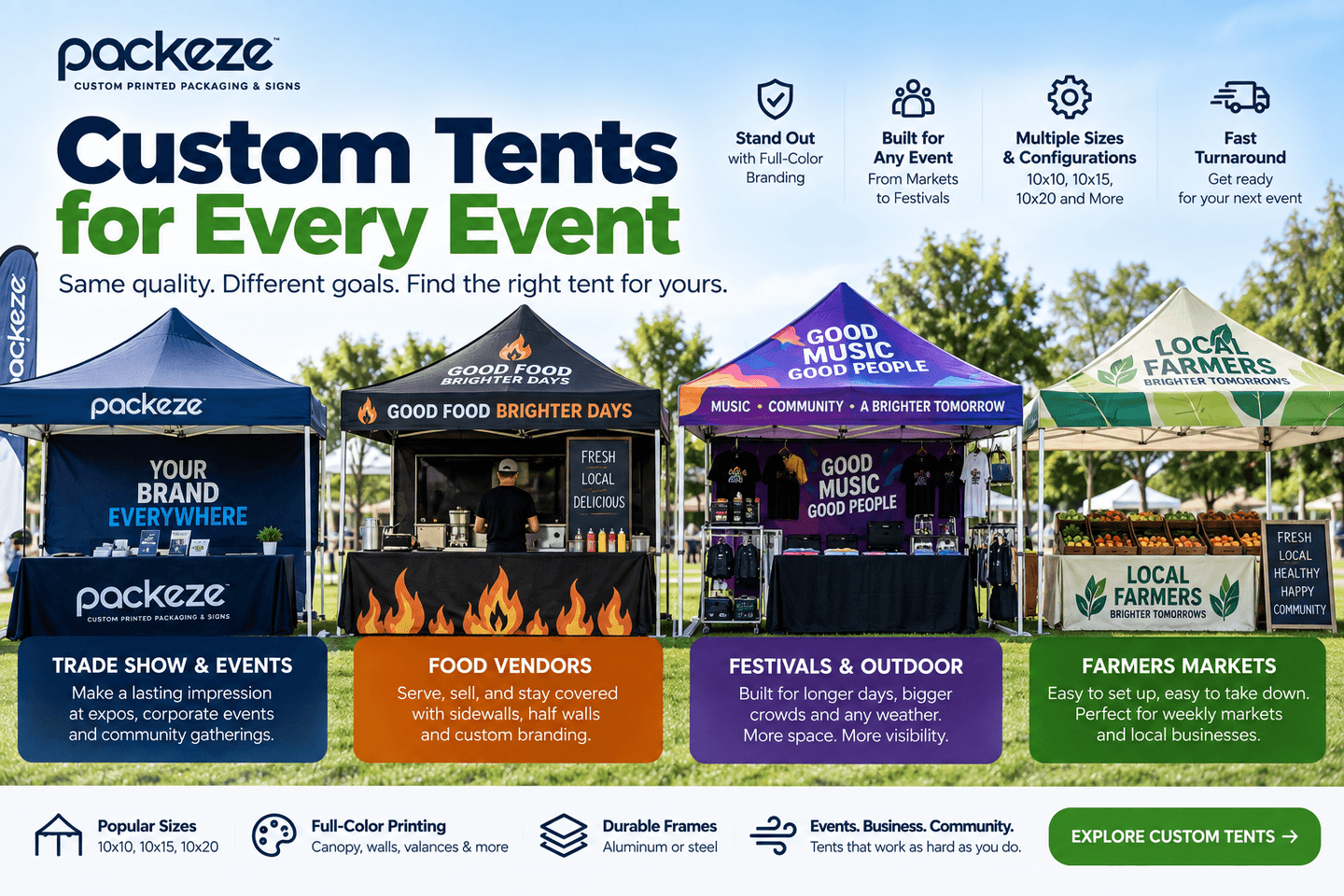
"Custom tent" covers a lot of ground. A trade show tent, a food vendor's cooking canopy, and a three-day festival setup all look similar folded up in a bag, but they're built for different jobs. This page walks through the use cases so you order the right one the first time.
WHAT'S THE DIFFERENCE BETWEEN AN EVENT TENT, A FOOD TENT, AND A FESTIVAL TENT?
An event tent is a general-purpose branded canopy for trade shows, sidewalk sales, and corporate outings. A food tent is the same basic frame with add-ons for serving, cooking, or holding product safely. A festival tent is built or reinforced for longer outdoor exposure — more wind, more sun, sometimes overnight setup. The frame is often the same across all three; what changes is the walls, the printing, and the hardware you add to it.
WHICH TENT SIZE DO YOU NEED?
Most vendors start with a 10x10 ft tent; larger events move up to 10x15 or 10x20 ft, or connect multiple 10x10 units into a run.
• 10x10 ft — one vendor table, one or two staff, standard booth space at most markets and trade shows.
• 10x15 ft — extra room for a second table, a small crowd, or food prep behind the counter.
• 10x20 ft — two-table setups, larger equipment, or a tent shared by two staff working side by side.
Check the space allotted by the venue or market organizer before you order — booth footprints are usually fixed and a tent that's too large won't fit the assigned spot.
DO YOU NEED A TENT WITH YOUR LOGO ON IT?
Yes, if the tent will be seen by customers, judges, or anyone deciding who you are on sight. A plain canopy tells people nothing; a tent with your logo on the canopy, and often the valance and back wall, turns a shade structure into a piece of signage that works the whole time you're set up. For a market stall or trade show booth, this is usually the highest-visibility branding you'll buy all year, because it's the thing people see from across the parking lot.
WHAT'S THE DIFFERENCE BETWEEN A BRANDED TENT AND A PLAIN CANOPY?
A branded tent is printed with your logo and colors on the canopy, walls, or both; a plain canopy is stock color with no imprint. The frame, poles, and stakes are usually identical between the two — the difference is entirely in the fabric. Vendors who use the tent regularly, at recurring markets or repeat trade shows, get the most value out of branding it, since the printing cost is spread across every use rather than a single event.
WHAT EXTRA FEATURES DOES A FOOD TENT NEED?
A food tent typically needs sidewalls, a back wall, and sometimes a half-wall counter so you can serve customers while keeping equipment and staff separated from the public. If you're cooking, check the tent's fabric and frame clearance around any heat source, and confirm venue rules on open flame before you set up — many festivals and markets restrict grills and fryers to specific zones regardless of tent type. Walls also matter for wind: a food tent with product on open shelving is more exposed to gusts than a trade show booth with nothing but a table and a banner.
WHAT SHOULD A FESTIVAL TENT HANDLE THAT AN EVENT TENT DOESN'T?
A festival tent needs to survive longer outdoor exposure with less supervision — full sun for a full day, wind across an open field, and sometimes an overnight stay if the event runs multiple days. Stake the frame down properly rather than relying on weight bags alone if the site allows stakes, and check the fabric's UV rating if the tent will sit in direct sun for hours at a stretch. An event tent used indoors or for a single afternoon outdoors doesn't need to meet the same bar.
WHAT'S DIFFERENT ABOUT A FARMERS-MARKET TENT?
A farmers-market tent gets set up and taken down far more often than an event or festival tent, so ease of assembly and frame durability matter more than they would for a once-a-year trade show unit. If you're at the same market weekly, a pop-up frame that goes up in a couple of minutes with one or two people saves real time over a season, and a heavier-gauge frame holds up to that repeated folding and unfolding better than a lightweight one built for occasional use.
WHICH TENT FRAME SHOULD YOU CHOOSE?
Aluminum frames are lighter and easier for one person to set up alone; steel frames are heavier but generally more resistant to bending under wind or repeated use. If you're carrying the tent to a market by yourself every week, aluminum is usually the more practical choice. If the tent stays in one place for a season or gets used by a two-person crew, the extra durability of steel can be worth the added weight.
CUSTOM TENT OPTIONS COMPARED
Use case | Typical size | Walls | Printing priority | Best frame trade-off
Trade show / event | 10x10 or 10x20 ft | Optional back wall | Canopy + back wall branding | Aluminum for easy transport between venues
Food vendor | 10x10 or 10x15 ft | Sidewalls, half-wall counter | Canopy + counter branding | Steel for stability around equipment
Festival (multi-day, outdoor) | 10x10 or 10x20 ft | Full walls for overnight security | High-visibility canopy branding | Steel plus proper staking for wind
Farmers market (weekly use) | 10x10 ft | Sidewalls for weather | Canopy branding for repeat recognition | Aluminum for fast solo setup
Once you know the size, wall configuration, and frame that fit your use case, you can build the exact spec on the custom tents page, including canopy printing and wall options.