

Retractable Banner Stands & Trade Show Backdrops: Sizes, Materials, Setup
WHAT IS A RETRACTABLE BANNER STAND?
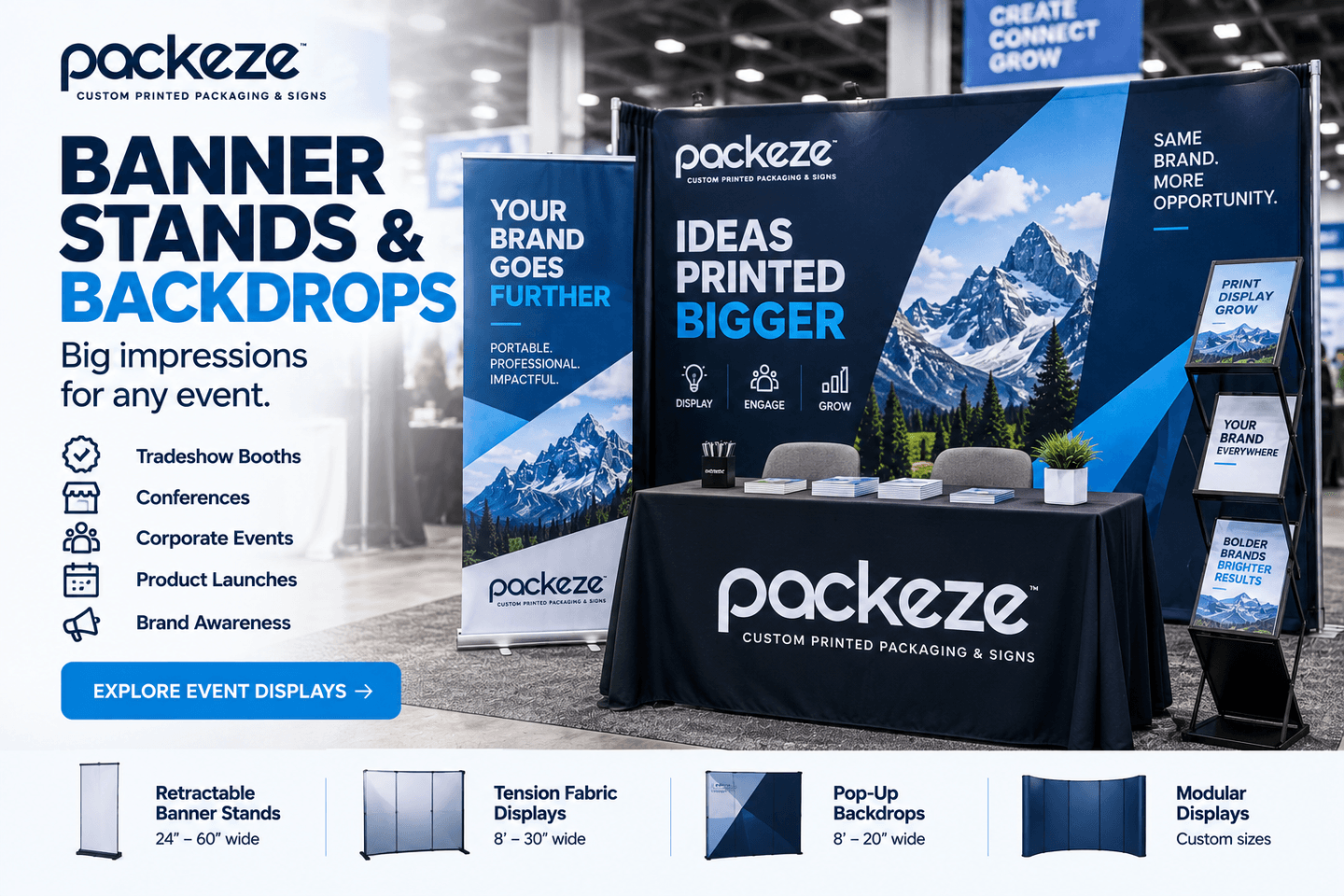
A retractable banner stand is a self-contained aluminum base with a spring-loaded roller inside it and a pole that extends up to hold the top of the graphic. The printed vinyl banner rolls up into the base when not in use and pulls out and locks in place for display. It is the single most common display at a trade show booth, a store entrance, or a registration desk because one person can set it up in under a minute with no tools.
WHAT IS A TRADE SHOW BACKDROP?
A trade show backdrop is the larger wall behind a booth, built either from a pop-up frame with printed panels, a pole-and-fabric tension system, or a modular panel display. Unlike a banner stand, a backdrop is meant to be the visual anchor of the whole booth, not a single accent piece next to the aisle.
WHAT IS A TENSION FABRIC DISPLAY?
A tension fabric display is a backdrop built from an aluminum pole frame with a printed fabric skin stretched over it like a pillowcase. The fabric is dye-sublimation printed, so the ink is part of the fibers rather than a surface coating, which means no glare under booth lighting and no cracking at the folds over repeated use. Tension fabric replaced a lot of the pop-up panel market over the last decade because the frames pack down smaller and the graphic itself can be swapped without buying new hardware.
RETRACTABLE STAND VS. TENSION FABRIC BACKDROP VS. POP-UP BACKDROP
Feature | Retractable banner stand | Tension fabric backdrop | Pop-up panel backdrop
Typical width | 2–5 ft, single unit | 8–30 ft, modular | 8–20 ft, modular
Setup time | Under a minute | 10–20 minutes for one person | 5–15 minutes for one person
Material | Printed vinyl banner | Dye-sub printed polyester fabric | Printed fabric or SEG panels on a magnetic/hook frame
Graphic replacement | Buy a new roll banner | Fabric skin only, keep the frame | Panels only, keep the frame
Packed size | Fits in one long padded bag | Frame and fabric fit in one rolling case | Usually two cases: frame and panels
Best for | Aisle-side accent, single message | Full booth wall, one continuous image | Full booth wall, tiling or curved layouts
WHAT SIZES DO RETRACTABLE BANNERS COME IN?
The industry-standard retractable banner width is 33 in by 79 in, and that is the size most stands ship as unless you specify otherwise. Common alternatives are a narrower 24 in by 81 in for tight aisles, a wide 47 in by 89 in for a bigger single-panel statement, and an extra-wide 60 in by 89 in used mostly for lobby and entrance displays rather than trade show aisles. Height on almost all models runs close to 90 in once the pole is fully extended, so the graphic reads at eye level to head-height for an average adult.
WHAT SIZES DO TRADE SHOW BACKDROPS COME IN?
Backdrops are sold by booth footprint, and the two footprints that match standard trade show real estate are 8 ft wide by 8 ft tall and 10 ft wide by 8 ft tall, corresponding to a standard 10x10 booth space. Beyond a single 8 or 10 ft unit, both tension fabric and pop-up systems are built in modular sections that connect side by side to fill a 20 ft or 30 ft island booth, and curved frame options are available where a straight wall would look flat under booth lighting. See the full range of formats on the indoor trade show displays page.
VINYL OR FABRIC: WHICH MATERIAL HOLDS UP BETTER?
Vinyl is the tougher, cheaper choice for a banner that gets rolled and unrolled at every event; fabric is the better choice for a large backdrop that needs to look flat and glare-free under bright booth lighting. Vinyl banners are printed on a scratch-resistant laminated stock built specifically to survive the retract-and-extend cycle of a roller mechanism thousands of times without the print cracking at the fold line. Fabric graphics cannot be rolled the same way — they are meant to be folded flat or rolled loosely around the frame poles — but because the dye is embedded in the fibers rather than sitting on a laminate surface, a fabric backdrop has no hot-spot glare under overhead lights, which matters more on a wide backdrop than on a narrow banner.
HOW LONG DOES SETUP ACTUALLY TAKE?
A retractable banner stand takes under a minute: extend the pole, hook the top of the banner, done. A tension fabric backdrop takes longer because the pole frame has to be assembled piece by piece before the fabric skin goes over it, usually a matter of minutes rather than seconds for one person working alone; a pop-up panel backdrop sits in between, since the frame unfolds in one motion but the individual graphic panels then have to be hung or clipped on one at a time.
SINGLE-SIDED OR DOUBLE-SIDED?
Single-sided is the standard choice for aisle-facing placement against a wall or booth back; double-sided is worth the extra cost only when the stand will be seen from both directions, such as in the middle of an open floor or at a registration point people approach from either side. A double-sided banner needs two printed graphics run back-to-back through the same mechanism, so it costs more than a single-sided unit of the same width and is not something to default to unless the placement calls for it.
DO YOU NEED A CARRY CASE?
Yes, if the stand is traveling to more than one event — a padded case protects the aluminum base and the rolled banner from the scuffs and dents that come from being loaded in and out of a vehicle repeatedly. Most retractable stands ship with a basic bag; heavier-duty rolling cases are a worthwhile upgrade for anyone doing several shows a year rather than one local event.
WHICH ONE SHOULD YOU BUY?
Buy a retractable banner stand if you need one focused message next to an aisle, a registration table, or a storefront and want something that sets up in seconds. Buy a tension fabric or pop-up backdrop if you are filling the back wall of a 10x10 or larger booth and need the whole space to read as one image from across the show floor. Many exhibitors run both: a backdrop as the anchor and one or two retractable stands flanking the entry points to the booth. Browse the full lineup of stands, backdrops, and other booth hardware on the event displays page.